
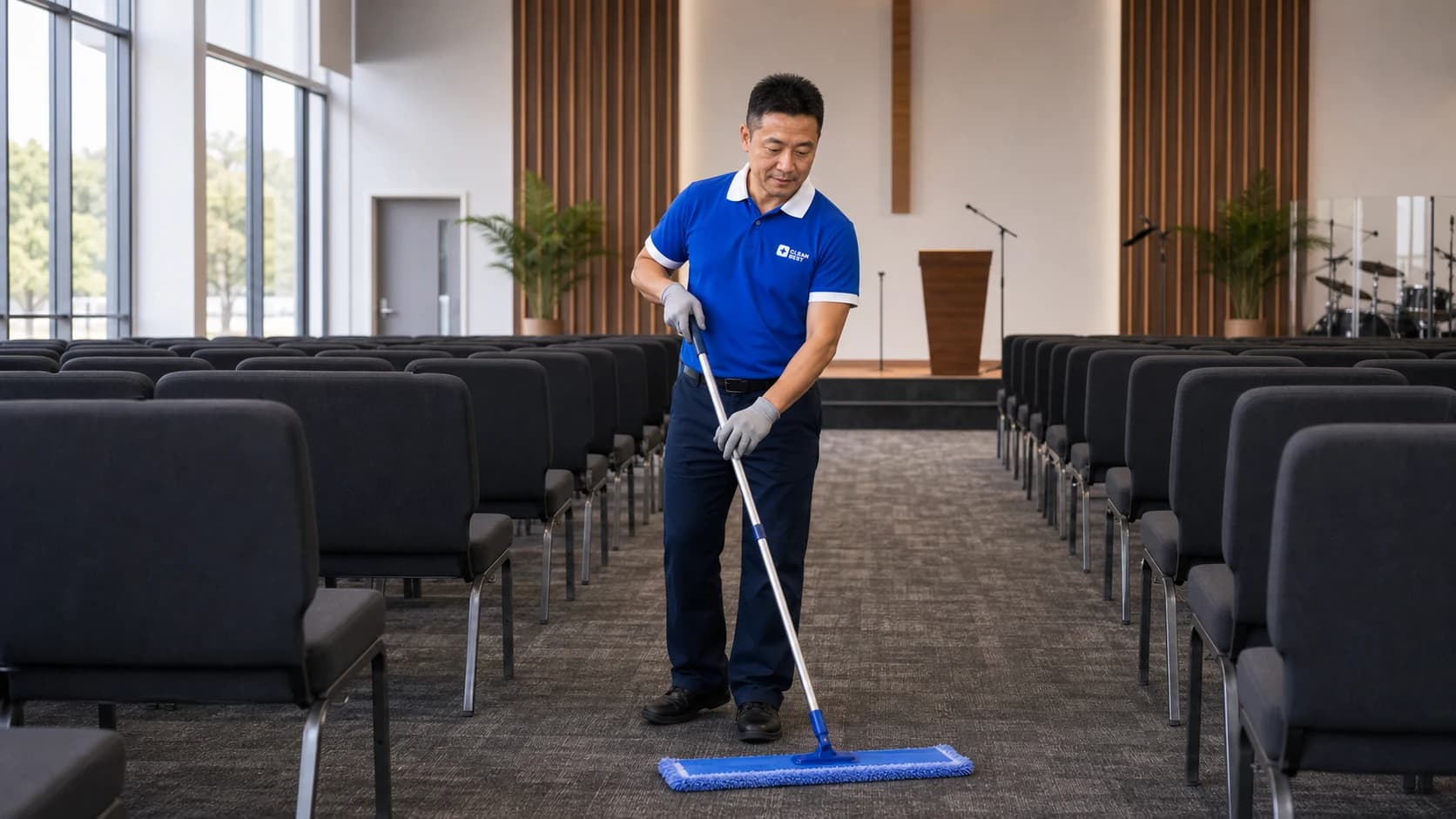
Places of worship
Church Cleaning Sydney
Cleaning for Sydney churches, chapels and parish halls, scheduled around your worship calendar. Pews, timber and stone floors, halls, kitchens and amenities cleaned by police-checked cleaners who handle sacred items only as your parish instructs.
- Scheduled around services, weddings and funerals
- Timber, stone and tile treated correctly, never stripped
- Sacred items and instruments touched only on instruction
- Police-checked cleaners and no lock-in contract
What you can hold us to
Every claim below is documented and we will send you the paperwork before the first shift.
- $20m public liability
- Certificate of currency on request
- Police-checked cleaners
- WWCC-cleared for childcare and schools
- No lock-in contracts
- Fixed written quote within 24 hours
What is church cleaning in Sydney?
Church cleaning is the scheduled cleaning of a place of worship and its surrounding buildings: the nave or auditorium, the pews or seating, the timber and stone floors, the hall, the kitchen and the amenities. It is scheduled around the worship calendar rather than a standard business week, so the building is ready before services, weddings, funerals and community groups.
Sacred items, instruments and anything on or near the altar or sanctuary are handled only on the explicit instruction of the parish. Clean Best cleans churches, chapels, parish halls and places of worship across Sydney, on a fixed written quote with no lock-in contract.
- Trading since 2015Sydney-based, family-operated
- Police-checked cleanersWWCC-cleared for childcare and schools
- $20m public liabilityCertificate of currency on request
- Written quote in 24 hoursFixed price, no lock-in contract
Churches and parish halls
Church cleaning Sydney parishes schedule around worship
A church is not a commercial building with a cross on it. The calendar does not run Monday to Friday, the surfaces are older and more fragile than anything in an office, and there are objects inside that a cleaner has no business touching without permission. That is why church cleaning Sydney parishes can rely on starts with a conversation rather than a quote: what is happening in the building each week, when it is genuinely empty, and what may and may not be handled.
Clean Best has been cleaning Sydney sites since 2015. Places of worship sit alongside our school, childcare and strata work — buildings where trust matters more than speed, where the people using the space have a relationship with it, and where a cleaner who quietly moves something they should not have moved does real damage that no amount of scrubbing repairs.
Working to the worship calendar
For most parishes the main clean lands on a Friday or a Saturday, so the building is ready for Sunday. Around that sit the smaller resets: after a midweek service, after the Friday playgroup, after a Thursday choir rehearsal that has left the hall full of chairs. Weddings and funerals come with their own rhythm and we treat them as scheduled work rather than as an interruption, booking as far ahead as your parish office can give us. Feast days, Christmas, Easter and the major services in your calendar get planned months out, because there is no point discovering in the third week of December that nobody arranged the clean.
If a funeral is added at short notice, call us. Moving a visit is not a problem, and it is the single most common request we get from parishes. What does not work is a rigid roster that ignores the building it is supposed to serve.
The line we do not cross
At the walkthrough we ask a direct question: what may our cleaners touch, and what may they not? The altar, the tabernacle, the ark, the shrine, the vessels, the vestments, anything blessed or consecrated, the instruments. The answers vary enormously from one tradition to the next and from one parish to the next, and it is not our place to guess. A named person from your parish gives us the instruction in writing, it goes on the site card, and every cleaner assigned to the building reads it before their first shift. If something needs moving and we do not have permission, we clean around it and tell you. That is the whole policy, and it does not bend.
The same goes for the organ and the piano. We dust around them and keep the area beneath and behind them clean, because dust is what actually harms an instrument. We do not touch the instrument itself, ever, unless your organist or music director has told us specifically what is acceptable.
Old surfaces, and the products that ruin them
Timber pews and floors are the surfaces most often damaged by well-meaning cleaning. Flooding them with water opens the grain. Coating them in a supermarket polish builds a film that traps dirt, yellows over the years and eventually has to be stripped off at real expense. We use a neutral, low-moisture method and we polish only where the parish specifically asks for it.
Stone is the other trap. Sandstone, marble and terrazzo are porous, and an acidic product will etch them permanently — a mark you cannot buff out and cannot undo. So no acids, no aggressive scrubbing, and a question before we start: has this floor been sealed, and if so with what? The wrong chemical strips a seal in a single pass. In older buildings we test in a discreet corner and show you the result before we take a machine across a nave floor. Brass and other metal fittings are dusted as standard and polished only on request, because over-polishing wears away detail that took a craftsman a very long time to put there.
Candle wax, and the Saturday morning it costs you
Every parish we quote mentions the wax. It ends up on the floor, on the pews, on the rails, in the carpet, and volunteers spend hours on it with a scraper and a hairdryer. Wax lifts cleanly with gentle heat and absorption, but the method has to match the surface. A solvent that takes wax straight off a tiled floor can leave a permanent shadow on sandstone, and carpet needs a completely different approach again. It is routine work for us and it is part of a normal visit rather than something we treat as an event.
The hall is usually the busiest building
On most sites the hall works harder than the church. Playgroups, meetings, rehearsals, community hire, funerals with a wake afterwards, and a kitchen that has to be food-safe every time it is used. We clean and reset the hall after each booking, stacking or laying out chairs and tables to whatever layout you want next, and we clean the kitchen and servery properly: benches, sinks, urn, cooktop, fridge exterior and floors. If your hall is hired out commercially, we clean between bookings rather than once a week, so a hirer never walks into another group's mess.
Amenities and baby-change facilities are cleaned, disinfected and restocked as part of the same visit, and the building is left locked and secured exactly as your parish has asked.
What it costs, and what you sign
We price on the size of the worship space, the number of buildings on the grounds, the floor and timber surfaces involved, and how many services and events run in a week. There are no dollar figures here because there is no honest way to price a building we have not walked. What you get is a free assessment at a time that suits the parish office, a written scope showing exactly what happens at each visit, and a fixed price confirmed in writing within 24 hours. No lock-in contract. Call 1300 494 983 and we will come and look at the building.
Timber, stone and brass
Old surfaces, and the products that quietly ruin them
More harm comes to a worship space from well-meant cleaning than from age. Timber pews and floors flooded with water open at the grain, and a supermarket polish builds a film that traps soil, yellows over the years and eventually has to be stripped off at real expense. We work neutral and low-moisture on timber, and polish only where the parish specifically asks for it.
Stone is less forgiving again. Sandstone, marble and terrazzo are porous, and a single acidic product etches them permanently. So we ask what a floor was sealed with before a machine goes anywhere near it, test in a discreet corner in older buildings, and show the parish the result before we take a machine across a nave. Brass is dusted as standard and polished only on request, because over-polishing wears away detail that cannot be put back.
- Timber cleaned low-moisture, never flooded or over-polished
- No acidic products on sandstone, marble or terrazzo
- Existing seals identified before any machine touches the floor
- Brass and metalwork dusted, polished only on request
What's included
What a church clean covers
This is the standing scope for a worship space and its hall. Periodic timber, stone and high-dusting work sits on top of it.
- Pews, chairs and kneelers wiped down, with timber cleaned using a finish that will not build up
- Hymn books, missals, cards and pew pockets straightened and reset for the next service
- Timber, stone, terrazzo and tiled floors each cleaned by the method that suits the surface
- Nave, aisles and sanctuary steps vacuumed or dust-mopped, including beneath the seating
- Entry doors, porches, handles, handrails and glass cleaned before every service
- Brass, timber and stone fittings dusted, with polishing done only where the parish asks
- Stained-glass sills, ledges, window frames and reachable surrounds dusted carefully
- Organ, piano and instrument surrounds dusted, with the instruments themselves left untouched
- Sacred items, vessels, vestments and altar furnishings handled only on explicit instruction
- Candle wax lifted from floors, pews, rails and carpet using the right method for each surface
- Parish hall floors swept and machine-scrubbed, with chairs and tables reset after events
- Kitchen and servery cleaned to food-handling standards, including the urn, sinks and benches
- Toilets and baby-change amenities cleaned, disinfected and restocked
- Bins emptied, entries and porches swept, and the building left locked and secured as agreed
We do not move, dust or clean anything within the sanctuary, tabernacle, ark, shrine or equivalent unless a named person from your parish has instructed us in writing exactly what may be touched.
At a glance
Surface by surface, and what we never use on it
Most damage in a worship space comes from well-meant cleaning. This is the method Clean Best uses on each surface, and what it keeps away from.
| Surface or item | How Clean Best cleans it | What we never do |
|---|---|---|
| Timber pews, kneelers and floors | Neutral, low-moisture clean | Flooding with water; polish that builds a film and yellows |
| Sandstone, marble and terrazzo | Treated as porous; tested in a discreet corner in older buildings | Acidic products; aggressive scrubbing |
| Sealed hard floors | Existing seal identified before any machine goes near the floor | Chemicals that strip a seal in a single pass |
| Brass and metal fittings | Dusted as standard; polished only when the parish asks | Routine polishing, which wears away detail permanently |
| Candle wax on pews, rails, stone and carpet | Gentle heat and absorption, matched to the surface | Scraping; solvent on sandstone or carpet, which leaves a shadow |
| Organ, piano and instruments | The surrounding area and floor kept dust-free | Touching the instrument itself without the music director's word |
| Altar, tabernacle, ark, shrine, vessels, vestments | Only what the parish has instructed in writing, on the site card | Anything not on that written instruction — we clean around it |
Pricing
Church cleaning quoted on the building, the calendar and the surfaces
We price on the size of the worship space, the number of buildings on the grounds, the floor and timber surfaces involved, and how many services and events run each week. The price is fixed in writing before the first clean.
Chapel or single worship space
Small chapels, meeting halls and single-room congregations with one amenity block.
- Cleaned before the main weekly service
- Seating, floors, entry and amenities every visit
- One consistent cleaner who learns the building
- No lock-in contract, and a fixed written price
Fixed price, confirmed in writing before we start.
Parish church and hall
A church with an adjoining hall, kitchen and amenities, running several services and community groups a week.
- Cleaning scheduled around services, weddings and funerals
- Hall reset after playgroups, meetings, rehearsals and community hire
- Kitchen and servery cleaned to food-handling standards
- Named supervisor and a periodic timber and stone floor program
Fixed price, confirmed in writing before we start.
Cathedral or multi-building site
Larger worship spaces and grounds with a school, an office, a hall and several amenity blocks.
- Team cleaning across every building on the grounds
- Periodic deep programs for stone, timber, brass and high dusting
- Event support before and after the major services in your calendar
- Documented schedule and a single point of contact for the parish office
Fixed price, confirmed in writing before we start.
Free on-site assessment, then a written quote within 24 hours.
How it works
Arranging a cleaner for your parish
Nothing is committed until the parish has the written scope and price. The instructions about sacred items are agreed before the first shift.
- 1
Talk us through the calendar
Call 1300 494 983 and tell us your service times, the groups using the hall, and when the buildings are genuinely free.
- 2
Walk the buildings with us
We look at the floors, the timber, the kitchen and the amenities, and we ask what may and may not be touched.
- 3
Fixed written quote
Within 24 hours you receive a scope, a schedule built around worship times, and a fixed price with no lock-in contract.
- 4
Cleaned before you gather
The same police-checked cleaner works your site, following the written instructions your parish has given about sacred items.
FAQ
Church cleaning questions we get asked most
How does church cleaning Sydney parishes book work around worship times?
Clean Best builds the cleaning schedule from your parish calendar rather than from a standard business week. For most parishes the main clean lands on a Friday or Saturday so the building is ready for Sunday, with a lighter reset after midweek services and hall bookings. Weddings, funerals and feast days are handled as scheduled extras, booked as far ahead as you can give us. If a service is added at short notice, call us and we will move the visit.
How do you handle sacred items, the altar and the sanctuary?
Clean Best does not touch sacred items, the altar or the sanctuary unless a named person from your parish has instructed us, in writing, exactly what may be handled. At the walkthrough we ask what is in scope and what is not: the tabernacle, the ark, the shrine, vessels, vestments and anything blessed or consecrated. Those instructions go onto the site card, and every cleaner assigned to your building reads them. If something needs moving and we lack permission, we clean around it and tell you.
Can you clean timber pews and stone floors without damage?
Clean Best cleans timber pews and floors with a neutral, low-moisture method rather than flooding them or coating them in a polish that builds up and yellows over the years. Sandstone, marble and terrazzo are treated as porous surfaces, so no acidic products and no aggressive scrubbing. If a floor has been sealed, we ask what with, because the wrong chemical strips a seal in a single pass. Older buildings are tested in a discreet corner first.
Do you remove candle wax?
Clean Best removes candle wax as part of a normal visit rather than as an event that needs a working bee. Wax comes off pews, rails, timber, stone and carpet using the method that suits the surface, which usually means gentle heat and absorption rather than scraping or solvent. Carpet and porous stone need the most care, because a solvent that lifts wax cleanly off a tiled floor can leave a permanent shadow on sandstone.
Do you clean the parish hall and kitchen as well?
Clean Best cleans and resets the parish hall and kitchen as well as the worship space, and for many parishes the hall is the busiest building on the grounds. We reset it after playgroups, meetings, rehearsals and community hire, including stacking or setting out chairs and tables to the layout you want. The kitchen and servery are cleaned to food-handling standards: benches, sinks, urn, cooktop, fridge exterior and floors. If the hall is hired out commercially, we can clean between bookings.
Are your cleaners police-checked?
Every Clean Best cleaner holds a current national police check, and Clean Best carries $20m public liability insurance. Most parishes give us key or code access and we work in an empty building, which is exactly why the checks and the coded key register exist. If your site also runs a playgroup, a school or youth programs where children may be present, we assign cleaners who hold a current Working with Children Check as well.
Can our volunteers stay involved?
Clean Best scopes the work around your volunteers rather than over them. Volunteers are wonderful at the things that genuinely need a parishioner: the flowers, the linen, the sacristy. They are less suited to scrubbing hall floors, descaling amenities and lifting candle wax at seven in the morning. We take the heavy, repetitive work and leave the parts your community wants to keep. Tell us at the walkthrough what your volunteers already do, and we will scope around it.
Keep exploring
Related Clean Best services
Parish sites often have more than one building. These are the services most often quoted alongside a church.
Arrange church cleaning Sydney parishes can rely on
A free walkthrough, a schedule built around your worship calendar, and a fixed written quote within 24 hours.